
Route: New York (all airports) → London (all airports) | Travel window: May 3–11, 2026 | Observed: Google Flights, late March 2026
1. The Observation: A Below-Market Window on One of the World’s Busiest Routes
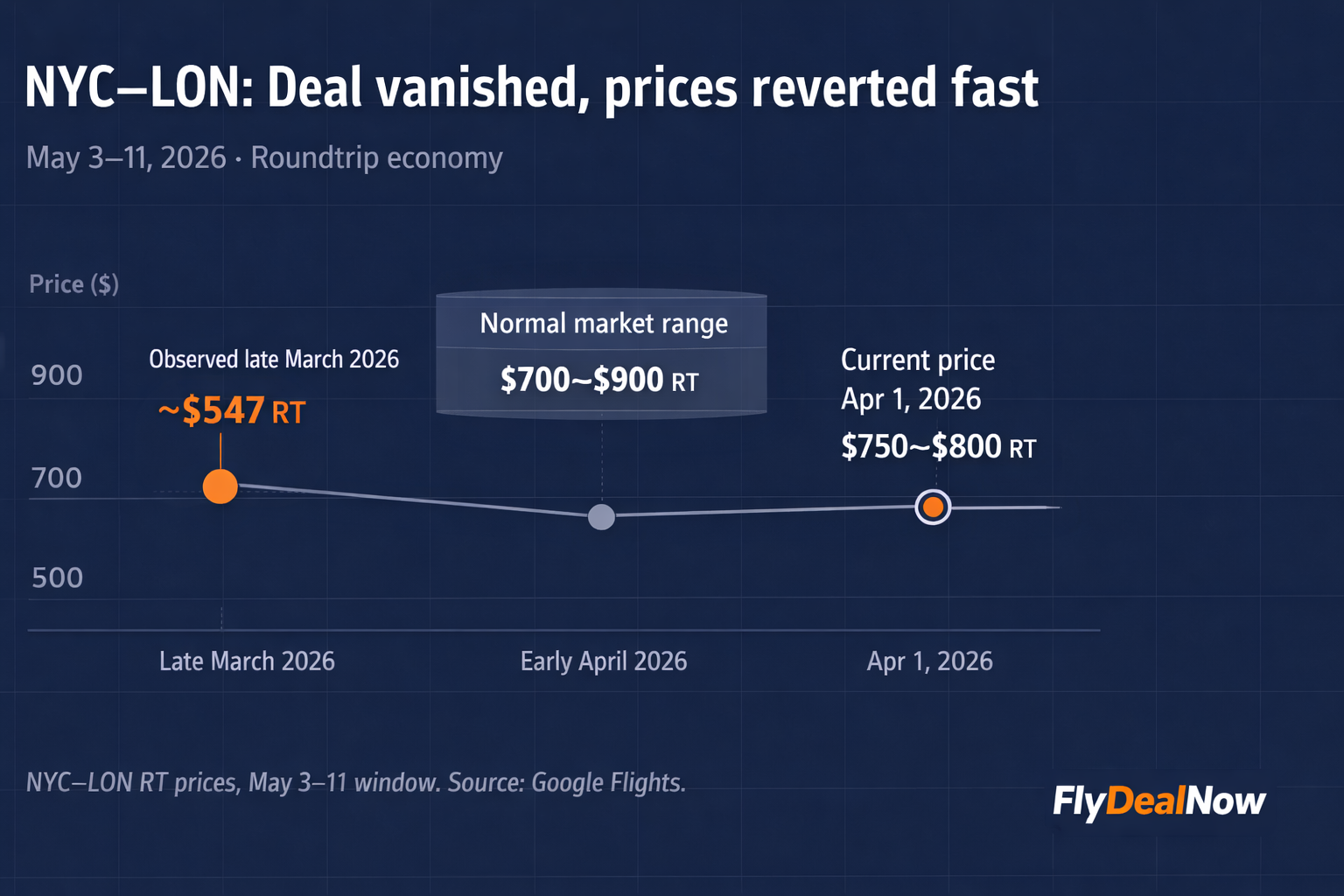
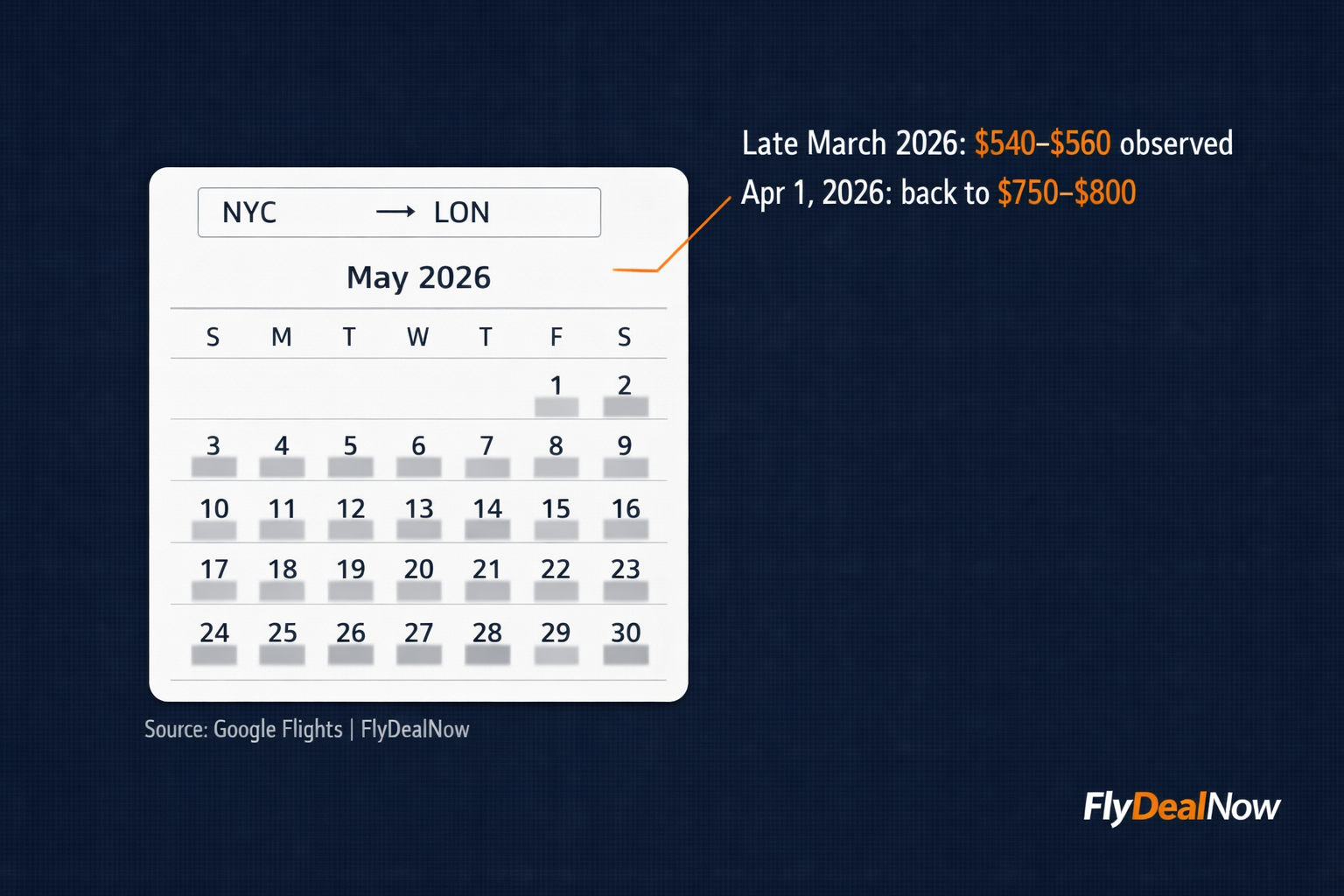
In late March 2026, roundtrip fares on the New York–London corridor for the May 3–11 window were sitting at approximately $540–$560 — with specific observations around $547 RT. On a route where the structural price range runs $700–$900 roundtrip, that represented a gap of roughly $150–$350 below the typical market rate.
That gap has since closed. By April 1, 2026, the majority of available fares for that same window had moved back up to $750–$800 RT, with Google Flights now labeling them “Typical.”
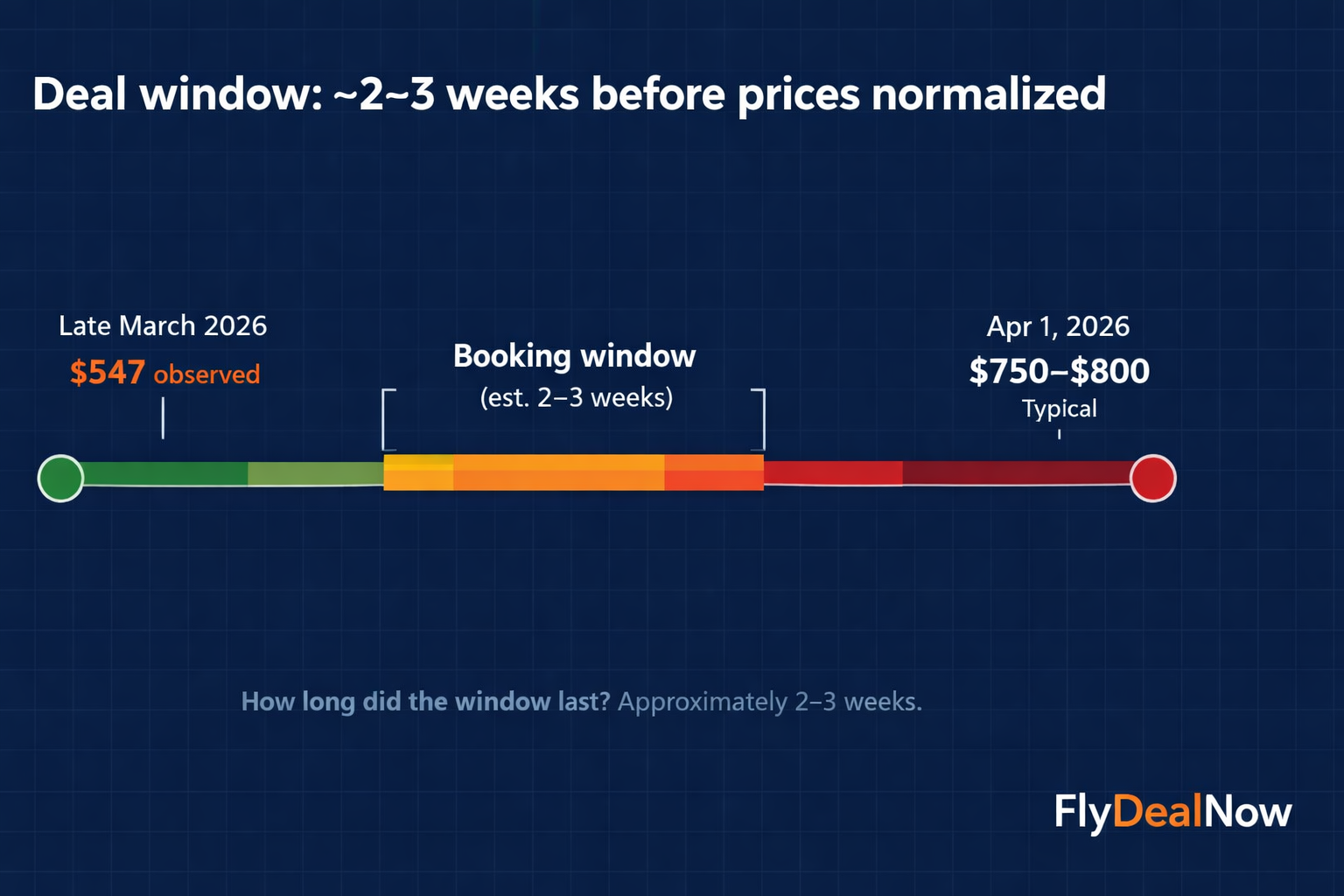
The window lasted weeks, not months. It is gone. This article isn’t about booking that specific fare — it’s about understanding what it was, why it existed, what replaced it, and whether the full trip to London in early May still makes financial sense.
2. The Data: What Was Observed, When, and How It Compares
The numbers are straightforward:
| Data point | Value | Source |
|---|---|---|
| Deal price observed | ~$540–$560 RT (ex. $547) | Google Flights, late March 2026 |
| Normal market range, this route | $700–$900 RT | Google Flights historical range |
| Current price (April 1, 2026) | ~$750–$800 RT | Google Flights, labeled “Typical” |
| Discount vs. low end of normal | –$153 (–22%) | Calculated |
| Discount vs. high end of normal | –$353 (–39%) | Calculated |
| Price recovery (deal → current) | +$203–$253 RT | Calculated |
The $547 fare wasn’t a mistake fare. It wasn’t a flash sale. It was a shoulder-season pricing window — a structurally predictable softening of fares on a high-volume transatlantic route, in the weeks immediately before peak summer demand kicks in. Airlines price these windows lower to stimulate demand for seats that would otherwise sit partially empty. When enough demand materializes — or when the booking horizon shortens — the floor rises.
3. Context: Why This Route Prices the Way It Does
New York–London is the highest-volume transatlantic corridor in the world. That volume cuts both ways: it creates competitive downward pressure on fares (multiple carriers, high frequency), but it also means demand is deep enough to support rapid price recovery the moment soft inventory tightens.
Early May sits in what the industry calls shoulder season — after spring break, before Memorial Day. It is structurally cheaper than late May through August. But “cheaper” is relative. The $547 window was at the lower end of what this route offers in shoulder season. A more typical shoulder-season fare on NYC–LON lands between $600 and $750 RT. The $547 observation was therefore a compressed window within an already favorable period.
The mechanics of the recovery are equally predictable. As departure approaches (May 3 is now roughly 5 weeks out from the April 1 observation date), airlines progressively fill lower fare buckets and reprice remaining inventory upward. The transition from “Deal” to “Typical” on Google Flights reflects that bucket rotation — not a change in demand structure.
Editorial position: This was a seasonal pricing anomaly, not a structural error. Its lifespan was always measured in weeks, not months. Travelers who saw it in late March had a genuine booking opportunity. Those who did not act have now returned to normal market conditions for this route and this window.
4. Analysis: What the Price Recovery Actually Means
The $203–$253 price increase between late March and April 1 is not noise. It is the cost of hesitation on a time-sensitive fare.
But here is the more important analytical point: the current $750–$800 RT fare is not a bad fare for NYC–London in early May. It sits at the low end of the structural range ($700–$900). It is not a deal. It is fair market value for shoulder season on this route.
The question for any traveler now looking at this window is not “did I miss the deal?” — the answer to that is yes, unambiguously. The question is: does the current price, combined with the full cost of a 7-night London trip, represent good value for what London offers in early May?
That is a total trip cost question, not a flight price question. And that is where the analysis needs to go.
5. Total Trip Cost: Flight + 7 Nights in London
A flight price is not a trip cost. On a 7-night trip to London, accommodation represents the second-largest line item after the airfare — and in London, that line item is significant.
The following estimates are based on general London hotel market rates for early May. They are not promotional prices and not tied to specific properties. Treat them as planning benchmarks.
5a. Budget Stays (Hostels / Budget Hotels)
London has a functional budget accommodation market — hostels, budget hotel chains, and outer-zone options — with dorm or basic private room rates generally running $90–$120/night in early May.
7-night cost estimate: $630–$840
| Scenario | Flight | 7 nights (budget) | Total |
|---|---|---|---|
| Had booked the deal | ~$547 | $630–$840 | $1,177–$1,387 |
| Booking at current price | ~$775 (midpoint) | $630–$840 | $1,405–$1,615 |
The difference between having caught the deal and booking now, at the budget accommodation level: approximately $228 on total trip cost — roughly the same $228 that evaporated on the flight alone. The proportional impact of the flight deal is real but partially absorbed by the fixed cost of accommodation.
5b. Mid-Range Stays (3-Star Hotels / Well-Located Independents)
Mid-range London hotels — 3-star properties, boutique independents in zones 1–2 — run $150–$220/night in early May.
7-night cost estimate: $1,050–$1,540
| Scenario | Flight | 7 nights (mid-range) | Total |
|---|---|---|---|
| Had booked the deal | ~$547 | $1,050–$1,540 | $1,597–$2,087 |
| Booking at current price | ~$775 (midpoint) | $1,050–$1,540 | $1,825–$2,315 |
At the mid-range accommodation level, the flight deal would have represented a 12–14% reduction in total trip cost — meaningful, but not trip-defining. A $228 saving on a $2,000 trip is a 11% discount. Significant if you’re budget-conscious. Not catastrophic if you missed it.
5c. The Hotel Multiplier Effect: Why Accommodation Reframes the Flight Decision
Here is the analytical point that most flight deal coverage ignores entirely: the hotel cost doesn’t just add to the trip budget — it contextualizes the flight price.
A $228 flight saving matters more on a $1,200 total trip (it’s 19% of the total) than on a $2,000 trip (it’s 11%). When travelers obsess over $50 fare differences while staying in a $200/night hotel, they are optimizing the wrong variable.
The inverse is equally true, and more actionable: if you’re planning a London trip and you can hold hotel costs to the lower end of the budget range ($90–$100/night, 7 nights = $630–$700), the current $775 RT flight is still a reasonable entry point for an 8-night London trip totaling under $1,500. That is a defensible total cost for transatlantic travel in shoulder season.
Editorial position: The missed flight deal is a $228 loss, not a trip-killer. London in early May at a total trip cost of $1,400–$1,600 (budget accommodation + current flight prices) remains at the lower end of what this destination realistically costs. The window for the optimal flight price closed. The window for a reasonable total trip cost has not.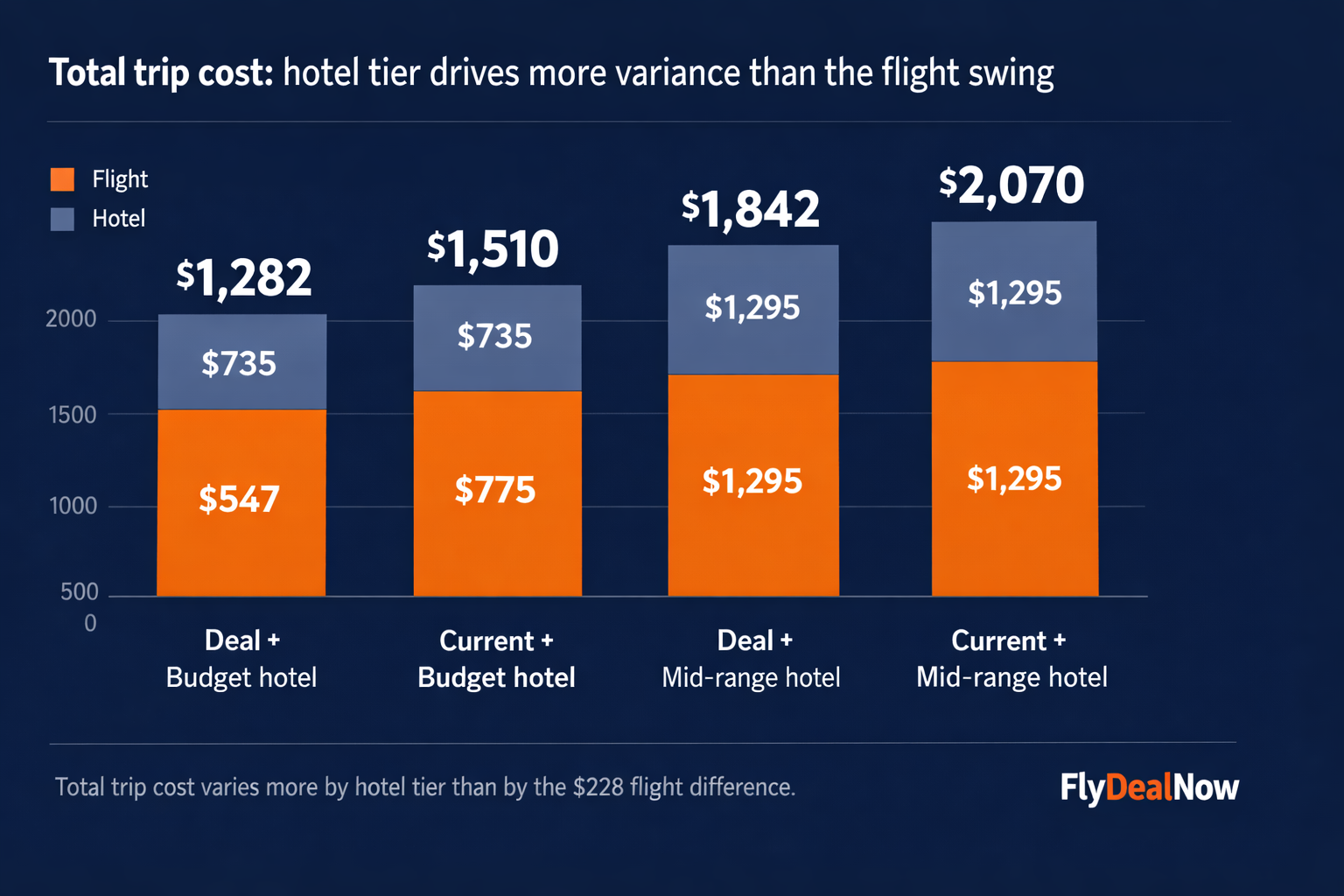
Looking for more route analysis? See our breakdown of NYC–London Has Reset to $750: What the Market Floor Tells You About May and Hidden Costs in Cheap Flight Deals for US Travelers (What They Don’t Tell You).
6. Should You Book? A Conditional Decision Framework
The $547 fare is gone. What remains is a decision about whether the current market conditions justify booking a May 3–11 NYC–London trip at all.
Here is how that decision breaks down by traveler profile:
If you travel light (carry-on only) and can use budget accommodation: The current $775 RT flight paired with $90–$100/night accommodation puts a 7-night London trip at approximately $1,400–$1,475 total. That is a reasonable shoulder-season price for transatlantic travel. The flight opportunity cost vs. late March is real but modest in context. This trip makes financial sense at current prices.
If you need checked baggage: Add $60–$100 RT depending on carrier. That narrows the gap further between this trip and a standard-season booking. Run the full numbers before committing.
If you’re planning mid-range accommodation: At $150–$220/night, your total trip sits at $1,825–$2,300+. At that spend level, the $228 flight premium you’re now paying is less than 12% of your total outlay. The decision becomes less about the flight price and more about whether London in early May at that spend level is the right choice for your travel goals.
If you were waiting to see if prices drop further: The move from “Deal” to “Typical” on Google Flights, at 5 weeks out, is a signal that further softening is unlikely on this specific window. Remaining inventory on popular departure dates tends to price upward from here, not downward. Waiting carries more risk than reward at this stage.
Bottom line: The optimal booking window for this deal closed in late March 2026. What the current market offers is fair — not exceptional, not punitive. A budget-conscious traveler who can manage accommodation costs aggressively can still reach a defensible total trip cost. A traveler whose London plans require mid-range comfort should enter with clear eyes about total spend, and make the decision based on the full number, not the flight price alone.
London in early May is worth going to. Whether the current prices make it worth going to right now depends on which column of the table above you’re living in.
Where to stay in London for this window → Search London hotels on Booking.com All accommodation estimates in this article are planning benchmarks based on general London market rates for early May 2026. Actual prices vary by property, location, and booking timing. Use Booking.com’s calendar view to compare specific dates before committing.
Data sources: Google Flights (observed late March 2026 and April 1, 2026). Hotel estimates based on general London accommodation market rates, early May 2026. All calculations are the author’s own.
FlyDealNow — We don’t just find deals. We explain them.
FlyDealNow Team
We help travelers pay less for flights using real pricing data — not hacks or guesswork.
✈️ Get My Personalized Flight Deal — $39or explore the Flight Pricing Blueprint — $29