
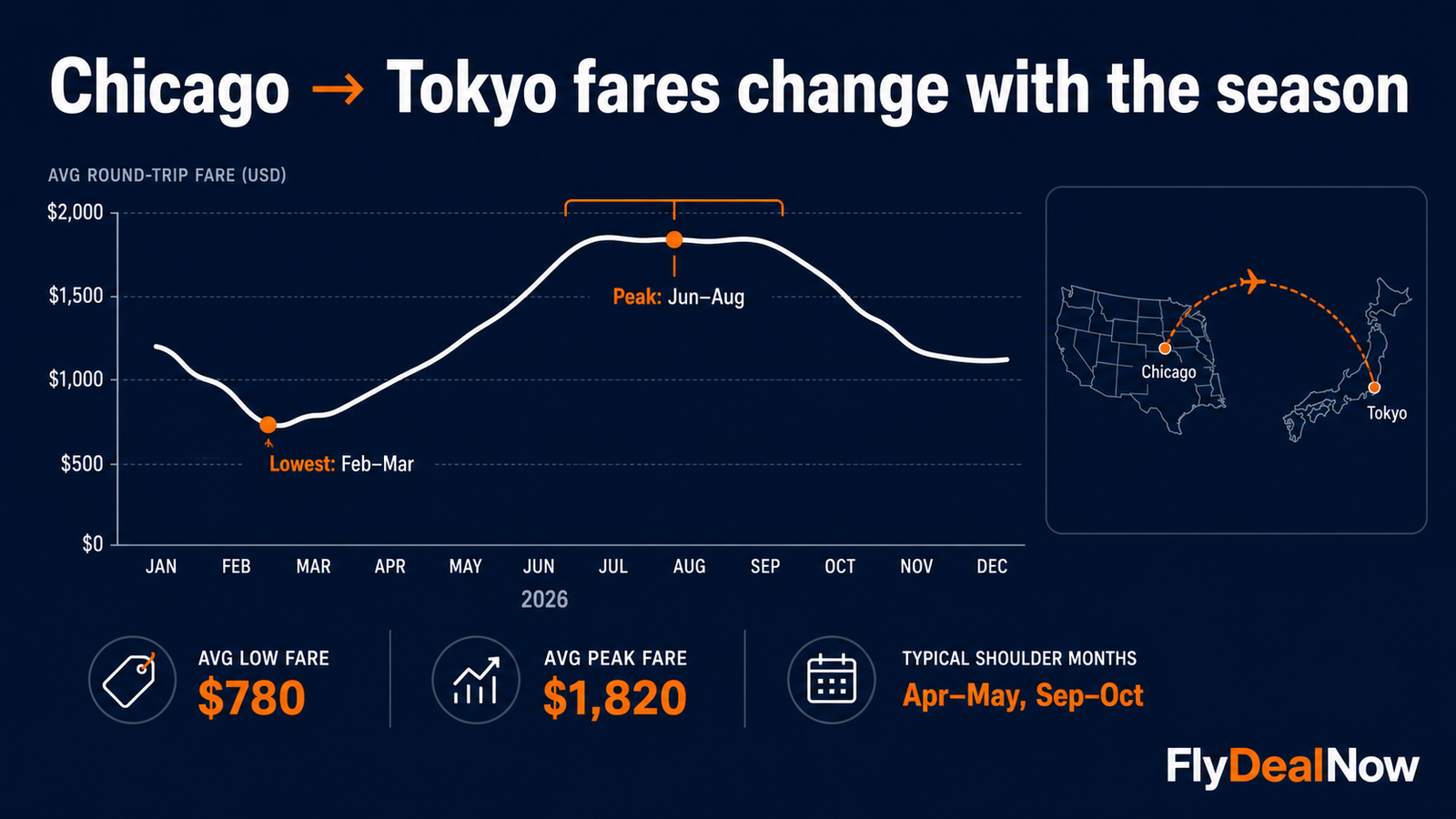
Route: Chicago O’Hare (ORD) → Tokyo Narita (NRT) Data observed: June 1, 2026 Source: Google Flights, Booking.com
VERDICT: BOOK — Late September window (Sep 28–Oct 12). Act before mid-July.
The $712 Gap Nobody Talks About
Most American travelers planning a trip to Tokyo assume the math is obvious: fly in summer, when you’re off work, when the city is alive, when everyone else is going. June or July. Book it.
The pricing data says otherwise.
On Google Flights, observed June 1, 2026, a roundtrip from Chicago O’Hare to Tokyo Narita departing June 28 costs $1,710 — and that’s with a connection. The cheapest nonstop on that window runs $2,228 on JAL/American. The same roundtrip departing September 28 costs $998 with a connection, and $1,868 nonstop on United or ANA.
That’s a $712 difference on the with-connection fare. $360 on nonstop. Per person.
For two travelers, the gap on nonstop alone reaches $720. That’s a hotel, a JR Pass, and a significant portion of your food budget in Tokyo — gone before you even land, simply because of the week you chose to fly.
This is not a sale. It is not a glitch. It is the seasonal pricing structure of the ORD–NRT corridor in 2026, driven by factors that repeat year after year. Understanding it takes five minutes. Missing it costs hundreds.
What Google Flights Actually Showed
Here is the data, exactly as observed on June 1, 2026.
Window 1 — Late June (June 28 – July 12, 14 nights)
- Cheapest fare: $1,710 roundtrip, Cathay Pacific, 1 stop via HKG
- Cheapest nonstop: $2,228, JAL/American
- Second nonstop: $2,258, ANA/United
- Google Flights label: Typical
Window 2 — Early August (August 1–15, 14 nights)
- Cheapest fare: $1,237 roundtrip, Air Canada, 1 stop via YYZ
- Cheapest nonstop available: $1,670 (best available with connection)
- Nonstop options: $2,093, United/ANA
- Google Flights label: High
Window 3 — Late September (September 28 – October 12, 14 nights)
- Cheapest fare: $998 roundtrip, Cathay Pacific, 1 stop via HKG
- Cheapest nonstop: $1,868, United
- Second nonstop: $1,868, ANA/United
- Google Flights label: High
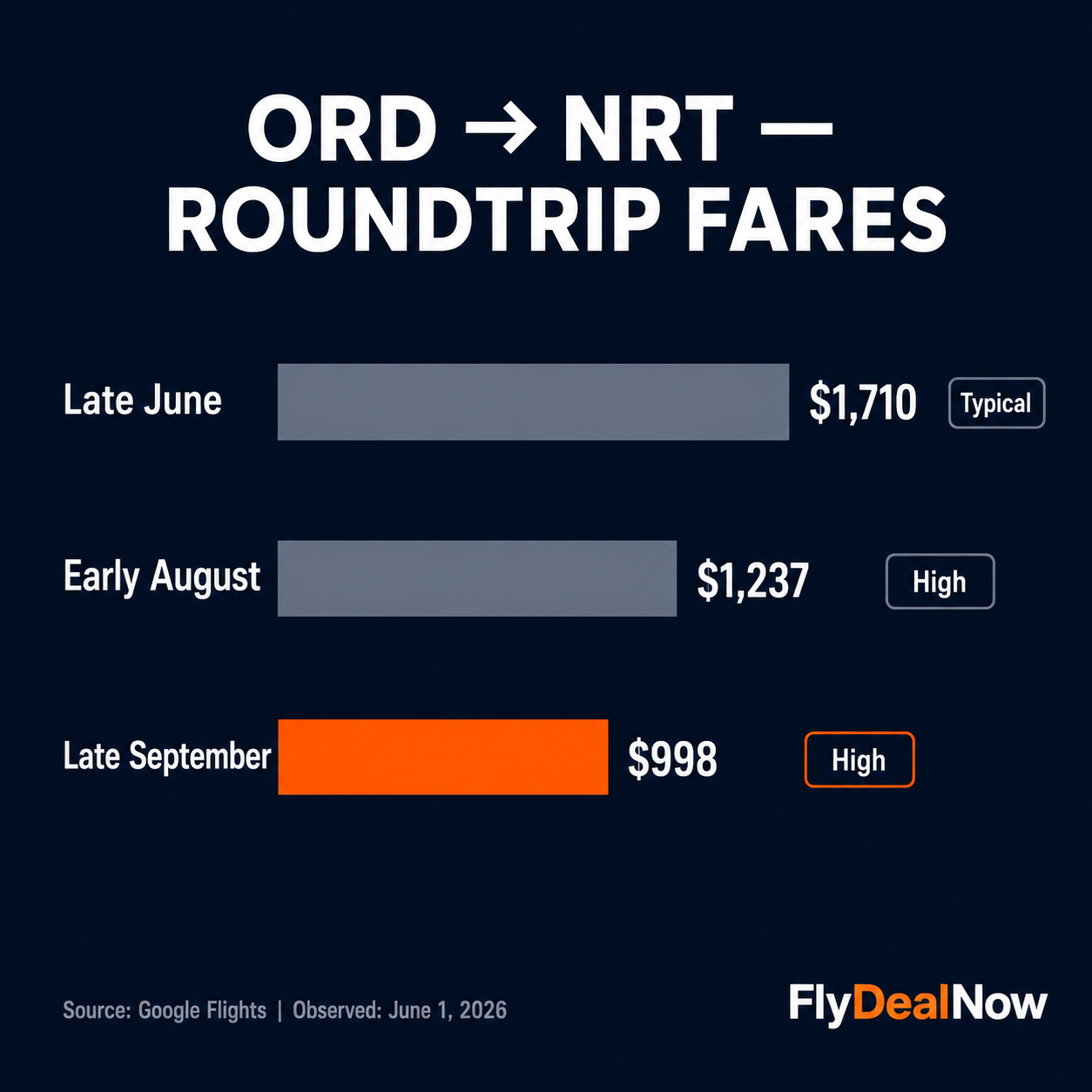
Three windows, three completely different price levels. The cheapest window is September — by a wide margin. But there is a wrinkle worth understanding.
The Google Flights “High” Paradox
Here is what makes this data unusual.
September is the cheapest window in absolute terms. A $998 roundtrip is the lowest price across all three windows. And yet Google Flights labels it High — meaning prices on that date range have risen recently compared to historical averages for the same period.
August is also labeled High. June is labeled Typical.
This is not a contradiction. It is a signal.
The “High” label on September does not mean September is expensive in absolute terms. It means the September window is getting more expensive right now, likely because the market has started to price it in response to demand building for fall Japan travel. The autumn foliage season — known in Japan as koyo — begins in late October, and travelers booking early are already pushing October-adjacent prices upward.
What the data is telling you: the $998 fare exists today, June 1. It may not exist in August.
The June “Typical” label means something different: those summer fares are not unusually high for the season. $1,710 for late June is simply what late June costs. There is no compression window incoming. No expected drop. That is the market floor for that period.
The structural read: September is cheap and under pressure. June is expensive and stable. If you want the cheaper trip, you book September — and you do it before the “High” label becomes a much higher number.
Why Summer Costs More — and Why That’s Not Going to Change
The ORD–NRT corridor serves one of the most popular international routes for American travelers. Tokyo has been the top or second-most-searched international destination among US travelers for three consecutive years, driven by the weak yen, aggressive destination marketing, and genuine demand from the first post-pandemic wave of Japan-curious travelers aged 25–40.
That demand is highest in summer. It always has been. School breaks, corporate vacation windows, and the logic that “Japan in summer sounds right” all concentrate bookings into June, July, and early August. Airlines on the Chicago–Tokyo corridor — United, ANA, JAL, American — price into that demand. When seats fill early, fares stay high. There is no mechanism that will push June fares down to September levels.
September works for a different reason: it sits between the summer peak and the autumn foliage peak. Late September into early October is statistically the quietest demand period on transpacific routes — school is back, summer travel is over, and koyo hasn’t started. Airlines have seats to fill. Prices drop.
There is also a weather argument. Tokyo in late June and July is hot and extremely humid — regularly 32–35°C with high humidity. September drops to the mid-20s, typhoon season is winding down, and the city is genuinely more comfortable to walk around in. The data favors September. So does the thermometer.
The Full Trip Cost: Flights + Hotel
Booking the cheaper flight only helps if hotel costs don’t erase the savings. Here is what Booking.com showed for the same 14-night period, 2 adults, observed June 1, 2026.
Hotel: APA Hotel Higashi Shinjuku Kabukicho Tower (3 stars, Very Good 8.1 — Shinjuku, subway access)
- June 28–July 12: $1,342
- August 1–15: $1,211
- September 28–October 12: data not directly comparable — see below
Hotel: Akabane Holic Hotel (3 stars, Excellent 8.7 — Subway access)
- June 28–July 12: $1,320
- August 1–15: $1,387
- September 28–October 12: $2,311
Hotel: APA Hotel Roppongi SIX (Very Good 8.1 — Roppongi, 2.3km from downtown)
- June 28–July 12: not listed in top results
- August 1–15: $978
- September 28–October 12: $1,052
The hotel picture is more nuanced than the flight picture. Some properties are cheaper in September; others — particularly higher-rated options — already reflect rising demand for the autumn shoulder season. The Akabane Holic Hotel, for example, is $1,320 in late June but $2,311 in late September. That is a $991 hotel premium for the same property — which partially offsets the $712 flight saving.
The key word is partially. Even with a more expensive hotel, the combined flight + hotel cost for the September window remains lower for most combinations. At APA Hotel Roppongi SIX, the September 14-night hotel total is $1,052 — compared to $978 in August. The difference is $74. The flight saving is $239 (nonstop) to $712 (with connection). The math still favors September across most hotel choices.
The practical filter: if you’re targeting a mid-range 3-star hotel with subway access in Shinjuku or Roppongi and you’re flexible on property, the September window wins on total trip cost. If you have your eye on a specific 4-star property that’s already pricing up for autumn season, run the numbers before assuming September is cheaper end-to-end.
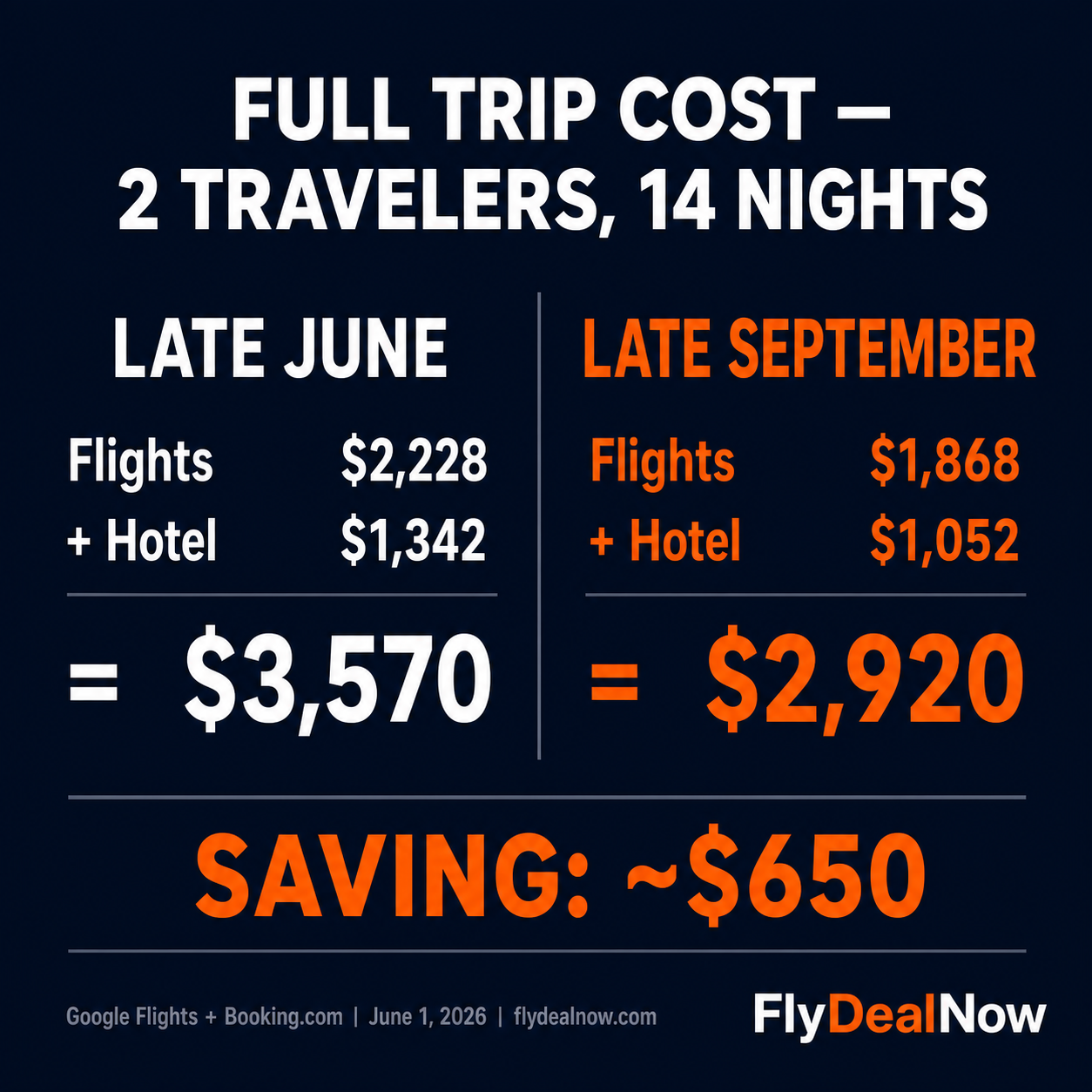
For a mid-range 2-person trip using a solid 3-star Shinjuku property and nonstop flights, the rough total cost comparison looks like this:
- Late June (nonstop + APA Shinjuku): $2,228 flights + $1,342 hotel = $3,570
- Late September (nonstop + APA Roppongi SIX): $1,868 flights + $1,052 hotel = $2,920
Total trip saving: approximately $650 for two people, just by shifting the travel window eight weeks.
The Verdict
Book — Late September window, departing September 28, returning October 12.
The conditions:
- If you want the cheapest possible fare with a connection: $998 exists today. Book it before the “High” label climbs further. Cathay Pacific via Hong Kong is a well-regarded carrier on this route.
- If you want nonstop: $1,868 on United or ANA is your number. It’s $360 less than the June nonstop equivalent and the same airlines.
- If you’re locked into summer: August 1–15 at $1,237 (connection) is a materially better option than late June at $1,710. The Google label says “High” but the absolute price is lower.
- If June is non-negotiable: $2,228 nonstop is the market rate. It will not drop meaningfully. Budget accordingly.
The one risk with September: the “High” label means this window is under pressure right now. The $998 fare is not guaranteed to last. This is not a recommendation to panic-book — but it is a reason not to wait until September to start watching.
One more thing: the yen. As of early 2026, the yen has remained weak against the dollar, which means once you land, your purchasing power in Tokyo is strong. Restaurants, transit, convenience stores, even mid-range hotels feel significantly cheaper in dollar terms than they did five years ago. The weak yen does not change the flight pricing, but it changes the overall value calculation of the trip.
The data points to September. The weather agrees. Book accordingly.
Looking for more route analysis? See our breakdown of Miami to Bogotá Flights in 2026: The $122 Pricing Gap Hidden in Plain Sight
and New York to Mexico City: The Cheapest Week Isn’t the One You Think
and why the same counter-intuitive pattern appears on Paris–Punta Cana, where shifting to low season costs you the nonstop option entirely.
Where to Stay in Tokyo Without Erasing Your Savings
Tokyo hotel pricing follows its own seasonal curve, and choosing the right property for your window matters. Here are options observed on Booking.com on June 1, 2026, across all three windows, for 2 adults, 14 nights.

For the September/October traveler:
APA Hotel Roppongi SIX — Very Good 8.1, Roppongi, 2.3km from downtown. $1,052 for 14 nights in the September window. Reliable APA brand, subway access, functional and clean. Good base for central Tokyo without paying Shinjuku premium prices. View on Booking.com
APA Hotel Sugamo Ekimae — Very Good 8.2, 5.5km from center, subway access. $1,015 for 14 nights in the September window. Further from the center but well-connected and significantly cheaper per night. Good option if you’re planning day trips and don’t need to be central.
DDD Hotel — Very Good 9.1, Subway access, 5km from downtown. $1,534 for 14 nights in September. Higher price point, but the 9.1 score reflects quality that typically means fewer trade-offs on comfort. Worth it if the budget allows.
For the summer traveler (June or August):
Akabane Holic Hotel — Excellent 8.7. $1,320 in late June, $1,387 in early August. Consistent pricing across summer windows, high guest score, good value for a property at this rating level.
APA Higashi Shinjuku Kabukicho Tower — Very Good 8.1, Shinjuku, $1,342 in June, $1,211 in August. Well-located in Shinjuku for nightlife and transit access. August comes in slightly cheaper despite the “High” flight label on that window.
The general rule for Tokyo: mid-range 3-star properties with subway access in Shinjuku, Roppongi, or Akasaka run $65–$95/night for two people across most windows. Budget-friendly options like APA chain hotels deliver consistent quality at $50–$75/night. Four-star and “Genius” tier properties jump to $130–$180/night and are where you see the autumn premium starting to bite.
Book your hotel at the same time as your flight, particularly for the September window. Hotels in that tier are already pricing up.
Search Tokyo hotels on Booking.com
FlyDealNow Team
We help travelers pay less for flights using real pricing data — not hacks or guesswork.
✈️ Get My Personalized Flight Deal — $39or explore the Flight Pricing Blueprint — $29